A Progressive Seder in Copenhagen

I just come home from a wonderful Seder in Copenhagen. (The Seder is a Jewish ceremonial dinner for the first night of Passover.) It is the second year I celebrate Seder with the Progressive congregation in Copenhagen, and I has become my favourite Jewish festival.
I snapped a few pictures during the evening. I thought I share some of them with you. The picture above is the most interesting. As you can see, there is an orange on the plate. Only Progressive Jews have an orange on the Seder plate. There is a story behind this new tradition. Tamara Cohen explains:
In the early 1980s, while speaking at Oberlin College Hillel [the campus Jewish organisation], Susannah Heschel, a well-known Jewish feminist scholar, was introduced to an early feminist Haggadah that suggested adding a crust of bread on the seder plate, as a sign of solidarity with Jewish lesbians (which was intended to convey the idea that there’s as much room for a lesbian in Judaism as there is for a crust of bread on the seder plate).
Heschel felt that to put bread on the seder plate would be to accept that Jewish lesbians and gay men violate Judaism like hametz [leavened food] violates Passover. So at her next seder, she chose an orange as a symbol of inclusion of gays and lesbians and others who are marginalised within the Jewish community. She offered the orange as a symbol of the fruitfulness for all Jews when lesbians and gay men are contributing and active members of Jewish life.
In addition, each orange segment had a few seeds that had to be spit out—a gesture of spitting out, repudiating the homophobia of Judaism. While lecturing, Heschel often mentioned her custom as one of many feminist rituals that have been developed in the last 20 years. She writes, “Somehow, though, the typical patriarchal maneuver occurred: My idea of an orange and my intention of affirming lesbians and gay men were transformed. Now the story circulates that a man said to me that a woman belongs on the bimah [podium of a synagogue] as an orange on the seder plate. A woman’s words are attributed to a man, and the affirmation of lesbians and gay men is erased. Isn’t that precisely what’s happened over the centuries to women’s ideas?”
Needless to say, gays and lesbians are not popular in Orthodox Judaism. Even in Conservative Judaism, homosexuals are being treated as second-class Jews. But in Progressive Judaism—an umbrella term for the Reform, Liberal, and Reconstructionist movements—all are considered equal in all areas. Gay Jews can get married and women can become rabbis.

There were some traditional dancing…

…and some symbolic burnt offering…

…and a Haggadah and plenty of matzoth…
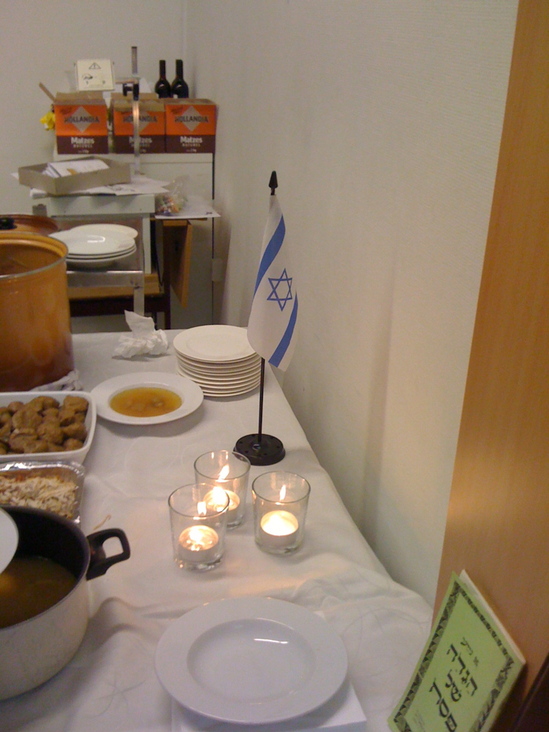
…and the flag of the Jewish homeland.